Many workers holding a Subclass 482 visa in Australia believe that working for their sponsoring employer for at least two years is enough to qualify for permanent residency (PR) through the Subclass 186 visa.
However, Next Gem has encountered a number of cases where workers had completed two years of employment but, upon a detailed assessment, did not meet all the requirements to apply under the Temporary Residence Transition (TRT) stream of the Subclass 186 visa.
So, why might two years of employment still not be enough to qualify? Let’s take a closer look at the requirements and key considerations in this article.
1. Requirements for transitioning from a Subclass 482 visa to a Subclass 186 visa
The Temporary Residence Transition (TRT) stream of the Subclass 186 visa is a permanent residency pathway for workers who have been employed in Australia under an employer-sponsored visa program and meet the requirements to transition to permanent residency.
According to the Australian Department of Home Affairs, applicants for the Subclass 186 visa under the TRT stream generally need to:
- Hold a Subclass 482 visa, Subclass 457 visa or an eligible Bridging visa.
- Have completed at least two years of full-time employment in Australia in eligible sponsored employment within the three years immediately before applying for the Subclass 186 visa.
- Have an Australian employer nominate them for a position, with the nomination approved by the Department of Home Affairs.
Therefore, completing at least two years of eligible employment is one of the key requirements for the Subclass 186 TRT stream. However, applicants must also satisfy other requirements relating to their personal circumstances and the employer’s nomination before the visa can be granted.
2. How is the two-year employment requirement calculated?
This is an important requirement that current Subclass 482 visa holders should pay particular attention to.
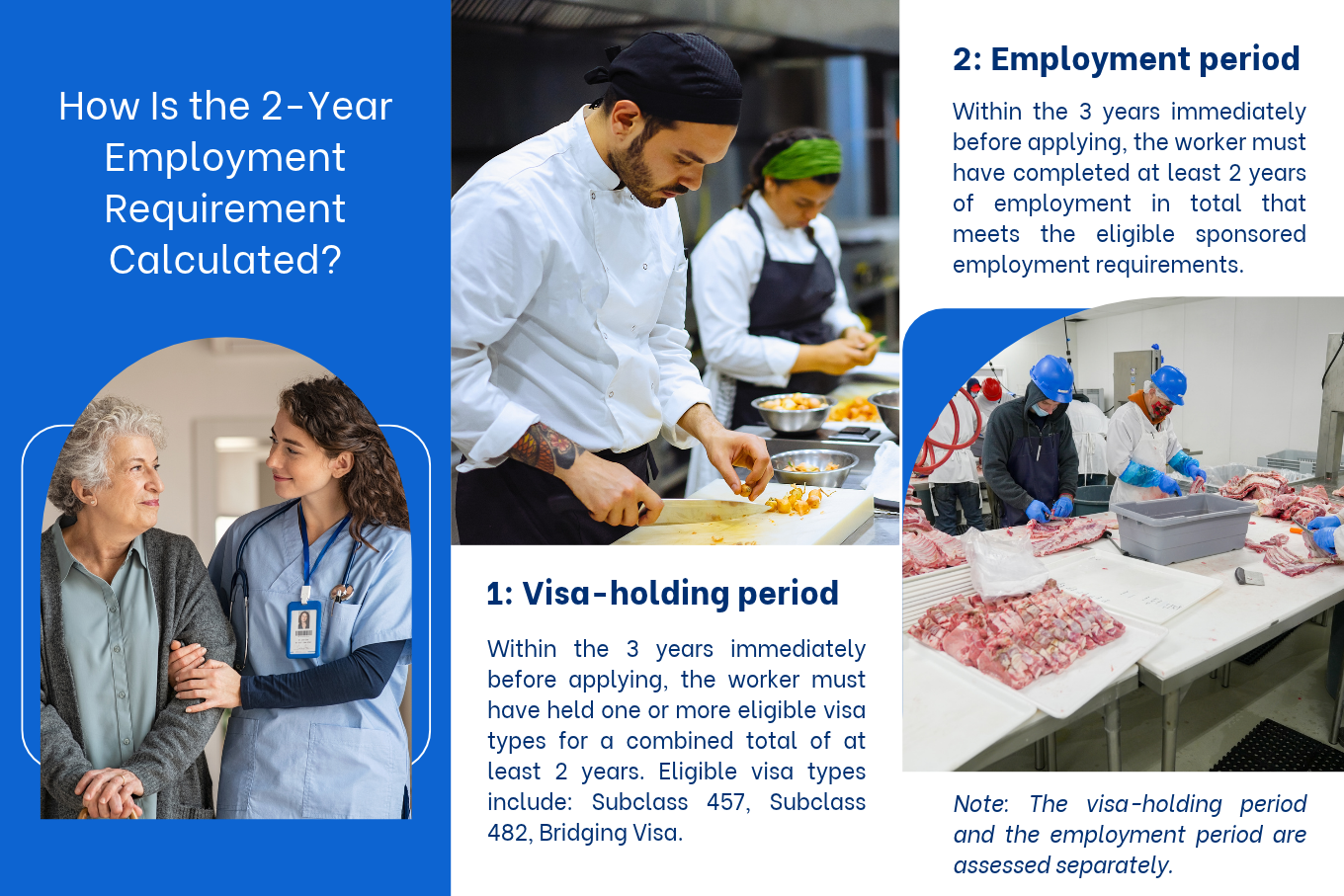
Under the Migration Regulations 1994, applicants for the Subclass 186 TRT stream must satisfy two separate time-related requirements.
First: Visa-holding period
Within the three years immediately before the date of application for the Subclass 186 visa, the applicant must have held one or more eligible visa types for a combined total of at least two years.
The eligible visa types include:
- Subclass 457 (Temporary Work – Skilled) visa.
- Subclass 482 (Temporary Skill Shortage) visa.
- Subclass 482 (Skills in Demand) visa.
- Certain Bridging visas specified under clause 186.226(1)(d).
Second: Employment period
Within the three years immediately before the date of application, the applicant must have completed a combined total of at least two years of employment that meets the relevant sponsored employment requirements.
In particular, the employment must generally satisfy the following key criteria:
- The applicant must have worked for an employer approved by the Department of Home Affairs as a work sponsor.
- The position must be in an occupation associated with the Subclass 457 or Subclass 482 visa held by the applicant.
- The employment must be full-time.
- The work must have been performed in Australia.
- Periods of unpaid leave are not counted towards the eligible employment period.
It is important to understand that the visa-holding period and the employment period are two separate requirements and must be assessed independently. Applicants should not rely solely on their employment commencement date to determine whether they have met the two-year requirement.
Example: Does completing two years of employment automatically mean you qualify?
Suppose a worker was granted a Subclass 482 visa on 1 March 2024 and commenced full-time employment with their sponsoring employer on 15 March 2024. They continued working until 15 March 2026, completing two years of employment.
However, before applying for the Subclass 186 visa, several factors still need to be checked:
- Does the period for which the worker held the Subclass 482 visa satisfy the requirement to hold an eligible visa for a combined total of at least two years within the three years immediately before applying?
- Does the entire two-year employment period qualify under the relevant sponsored employment requirements?
- Were there any periods of unpaid leave that need to be excluded?
- Did the actual position and duties align with the occupation associated with the visa granted to the worker?
- Is the employer still willing to nominate the worker for the position?
If these factors have not been properly assessed, completing two years of employment alone is not sufficient to establish that the worker is eligible to apply for the Subclass 186 TRT stream.
3. Do you have to work for the same sponsoring employer for two years?
Not necessarily.
From 7 December 2024, the Australian Department of Home Affairs introduced changes to the TRT stream to provide greater flexibility for workers seeking to transition to permanent residency.
Under the Department’s changes, workers may be able to combine eligible periods of sponsored employment with different employers, rather than being restricted to the time spent working for their current sponsoring employer.
Some important points to note include:
- Eligible periods of sponsored employment with different employers may be combined.
- Employment in a related field or following a promotion may be counted, provided the applicable requirements are met.
- Workers must provide supporting evidence to demonstrate that their employment periods satisfy the relevant requirements.
However, this does not mean that every job previously held in Australia will count towards the two-year requirement.
Workers need to review their visa history, sponsorship arrangements, occupation and actual employment duties against the requirements of the TRT stream.
In particular, when changing sponsoring employers, it is important to check the employment commencement date, when the employer lodged the nomination application, and the status of that nomination.
In addition to the visa-holding and employment requirements, applicants must also meet other criteria, including:
- Age: Generally under 45 years of age at the time of application.
- English language: Meet the Competent English requirement (IELTS 6.0, with no individual band score below 6.0).
- Employer sponsorship: Have an employer nominate an eligible position. The nomination must be approved, and the position must remain available to the applicant.
- Skills and work capacity: Meet any applicable requirements relating to the ability to perform the nominated role, including providing evidence if requested by the Department.
- Health and character: Satisfy the health and character requirements under Australian migration law.
4. Situations Subclass 482 visa holders should consider before applying for a Subclass 186 visa
In practice, Next Gem has encountered several situations that our Migration Agent believes require careful assessment before an applicant decides to lodge a Subclass 186 visa application. These include:
Case 1: The worker has completed two years of employment but has taken periods of unpaid leave.
Case 2: The worker has changed sponsoring employers and is unsure whether employment periods with different employers can be combined.
Case 3: The worker has been promoted or has taken on different duties from those associated with their original sponsored position.
Case 4: The worker has completed two years of employment but is approaching the age of 45.
Case 5: The worker meets the personal eligibility requirements, but the employer is no longer able or willing to provide sponsorship.
Therefore, completing two years of employment is an important requirement, but it does not automatically mean that a worker is eligible for the Subclass 186 TRT stream. Applicants must also satisfy the visa-holding period, eligible sponsored employment, age, English language and employer nomination requirements.
Assessing eligibility for the transition to a Subclass 186 visa requires a comprehensive review of the applicant’s visa history, employment records and individual circumstances, rather than simply looking at the total length of employment.
At Next Gem, our Migration Agent can assist with reviewing your circumstances, assessing your supporting documents and comparing your eligibility against the current Australian migration legislation and requirements. This process helps identify which requirements have been met, which matters need further clarification and whether any eligibility gaps remain, giving you a clearer basis for deciding on the appropriate timing and approach for your application.
The information in this article is based on official legislation and guidance available at the time of writing and is intended for general information purposes only. It does not constitute migration advice for any individual case. Readers should check the latest information published by the Australian Department of Home Affairs or consult a registered Migration Agent at Next Gem before making any decisions.
>> If you currently hold a Subclass 482 visa and would like to assess your eligibility to transition to permanent residency through the Subclass 186 visa, contact Next Gem at team@nextgem.com.au to book a consultation with our Migration Agent and receive an assessment based on your individual circumstances.
Registered Migration Agent: Yen Ngo
MARN: 2619560
Publication date: 11 November 2026